
In late February, an incredible spectacle comes to Nebraska. Thousands of migrating sandhill cranes fill the skies and the cornfields along the Platte river. Every spring, sandhill cranes migrate from their winter habitat in the southern United States and Mexico to their northern breeding habitat which reaches as far as Alaska. Their migration route bottlenecks in Nebraska, between North Platte, Kearney and Grand Island, where thousands of cranes gather.
For the past three years I have gotten the opportunity to visit the Platte River valley and view the migrating cranes. I am a photographer and the crane migration presents an incredible opportunity to get some amazing pictures, as well as experience the awe of the migration.
During the day the cranes can be found foraging for leftover corn in farm fields. As you drive into Kearney or Grand Island, you’ll see that many of the surrounding fields are filled with the iconic, tall, slender, gray birds. It is quite the spectacle to see typical Nebraska cornfields, not completely bare, but instead filled with cranes.
Often, the best place to look for sandhill cranes is along backcountry roads. As my family and I drive along these dirt roads I usually pull out my camera. I generally try to find a spot where the cranes are closer to the road so I can get a good close up shot.
To get a good picture I have to roll down the window. This adds a whole new dimension to the crane spectacle: the sounds of the cranes. The sounds echo across the fields and valleys. It can best be described as a rolling gargle or cawing noise. It is what I like to imagine a field of dinosaurs may have sounded like. I stick my lens out the window and take bursts of shots (admittedly I have many similar pictures of a “crane standing in a field”). I burst photos in hopes of capturing the cranes up and moving, bouncing, or showing their wings.
If you are viewing the cranes at the right time of day, many cranes can be seen flying from field to field or simply coming in for a landing. This makes for good pictures as well. As the cranes fly over the road I can capture close-ups of the cranes in flight. Some of my best bird photography has come from me standing on a dirt road in the middle of a cornfield.
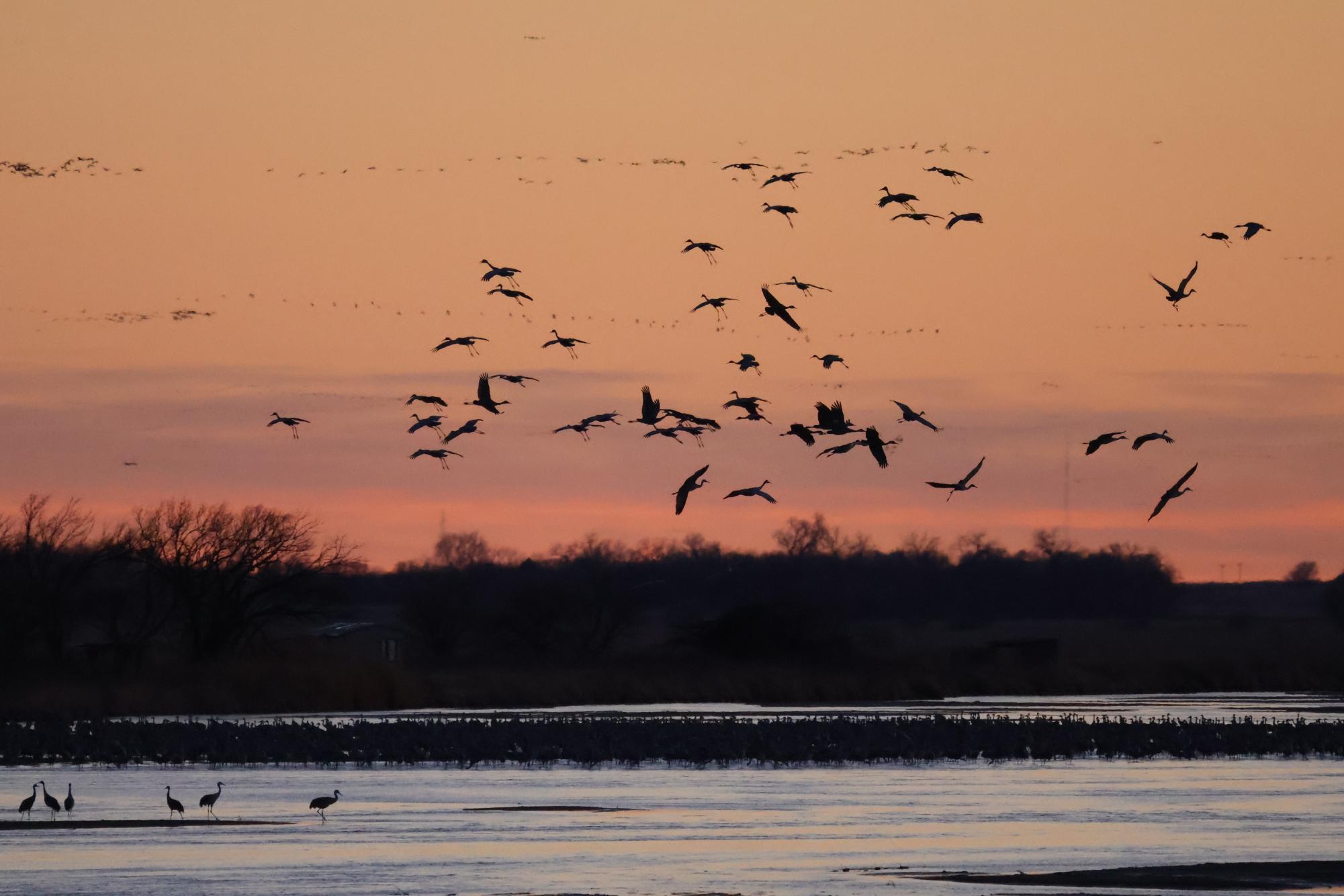
The flying and landing cranes are fascinating to watch. Their coordination is incredible. When they fly in groups, they organize themselves into massive “v” shapes. It is amazing to me that the cranes never run into each other. When the birds decide to land their legs stick out. They have these long spindly legs that don’t seem quite proportional to the rest of their bodies. It is almost as if they have “landing gear”. When the cranes descend they look like they are using their wings as a parachute. When they get closer to the ground, they swiftly flap their wings, and then touch down. I have many pictures of huge flocks of cranes all descending in unison.
At night time, the sandhill cranes roost on the Platte. When dusk rolls around, thousands of birds can be seen coming in and landing on the river. There are several sanctuaries and lookout points to view the cranes as they come in. We try to view the cranes at night as they come into the river and in the morning as they fly back to the fields. It is an incredible sight to see cranes upon cranes moving in unison and landing on the Platte. The sounds of their caws fill the sky.
When viewing the cranes in the morning, you have to arrive at a lookout point early, ideally at or before sunrise. While getting up early is not very fun, seeing the cranes take off is worth the loss of sleep. On our most recent trip, we went to a lookout point that we had never been to in the morning. It offered good crane views with the rising sun as a backdrop. The lookout point was near a road that had safety barriers held up by wooden blocks. There were many shrubs and grasses along the river which made it hard to get a clear view of the birds. Luckily, I was able to stand on one of the wooden blocks and get some great, unobstructed pictures. On past trips, viewing the cranes in the morning has allowed me to get shots of the birds with the moon in the background making for a striking composition.
It was cold that morning and a little unpleasant to be outside so early, but when I look back, I mostly remember how awesome it was to see the cranes taking off and the golden orange, sun streaked sky behind them. Viewing the cranes serves as a reminder to me of just how beautiful Nebraska is. I think often we get focused on the mountains and the forests of nearby states and forget about the uniqueness and the beauty of the prairie. There is something magical about the crane sounds, the bird filled skies, and the wide winding Platte River. Viewing the cranes serves as another reminder for me of how important it is to preserve Nebraksa’s great and underappreciated ecosystems.