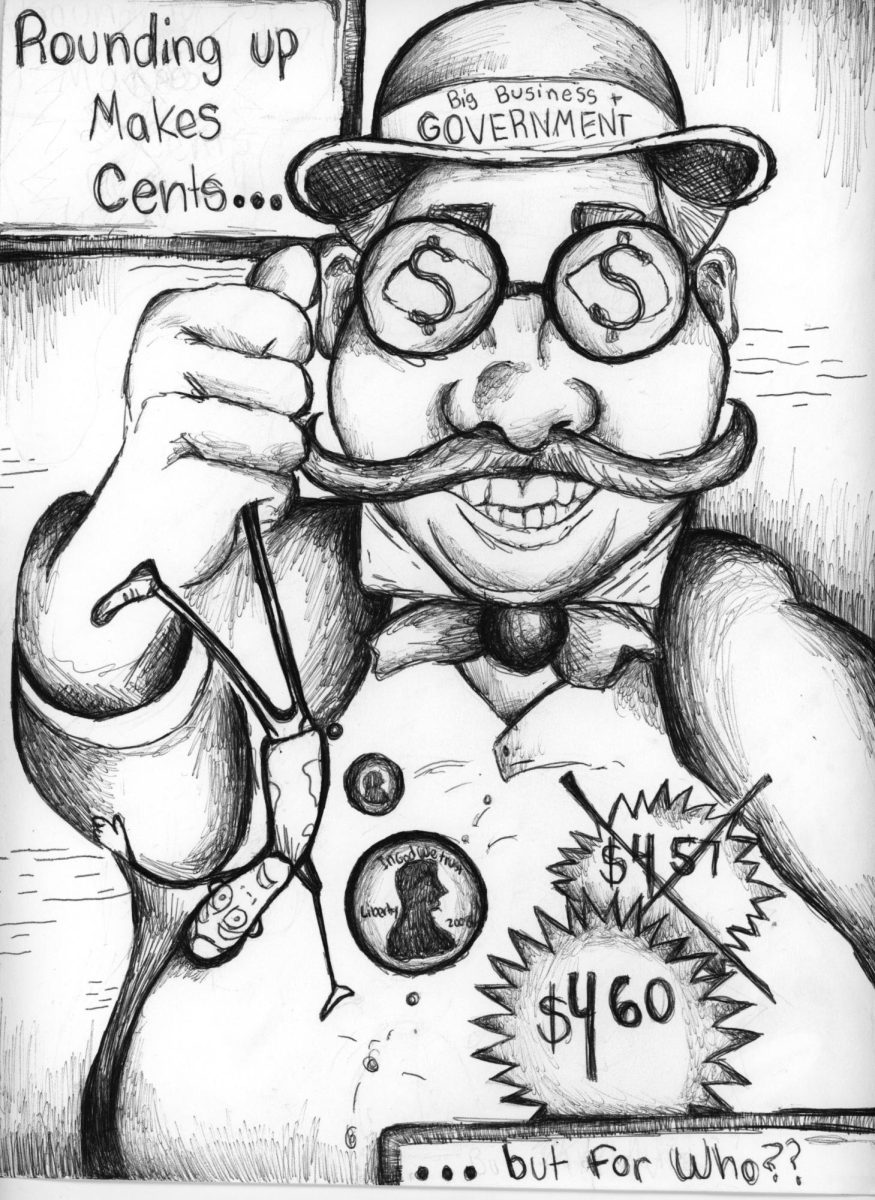
The debate over the penny has been boiled down to a single, misleading number: the fact that it costs the government more than one cent, about $0.037, to create it. However, if we choose to define the penny’s value by its production expense, we completely ignore its function as the foundation of consumer pricing. Continuing to distribute the penny isn’t a wasteful exercise in nostalgia; it’s a critical, low-cost investment that prevents systematic upward rounding—a hidden inflation caused by the removal of pennies that would cost American consumers far more than the Treasury saves. The simple truth is, we can’t afford not to make the penny.
We are not discussing hypothetical losses, but rather a quantifiable and systematic wealth transfer. With the halt of penny production in November of this year, the United States Treasury saves roughly 56 million dollars a year. However, we must also focus on the people of our country and the quantifiable costs this change creates for them.

Within the ‘No Penny’ world, we must face a harsh truth: imposed rounding tax.
Without the penny, we are unable to fulfill a store’s request for a price like $4.57. Instead, these prices will have an increase in cost. According to the Federal Reserve Bank of Atlanta, numbers 1 and 2 will round down to 0, 3, 4, 6, and 7 will round to 5 cents, and numbers 8 and 9 will round up to 10. Thus, $4.57 would become $4.60. While this may not seem like a big deal, it is estimated that this will cost consumers as a whole hundreds of thousands, if not millions and billions of dollars annually, a hidden levy far surpassing the government’s savings.
Furthermore, this issue will cause a greater increase in the poverty America faces, an issue we have been trying to fight for since 1964, when Lyndon B. Johnson declared an ‘unconditional war on poverty’ in his inaugural address.
Low-income Americans rely more on the physical use of cash in their everyday lives for transactions than high-income earners, who primarily use debit or credit cards. This seems unrelated, but it truly is the manifestation of pure injustice. According to the Federal Reserve “97% of households with $100,000 or more use credit or debit cards.” Those who rely on cash will come to face the rounding tax at every transaction, causing an increase in prices for those who are already struggling financially. Those who fall back on debit or credit cards will continue to pay those flat prices, like the $4.57 mentioned earlier, because they aren’t using physical currency.
The systemic upward rounding isn’t just an abstract economic calculation; it’s a direct, unfair burden. For those struggling with financial precarity, the penny’s removal becomes nothing less than a regressive tax, punishing the poor for their method of payment. Those privative people living paycheck to paycheck will face taxation on necessary items vital to life (ie, their meals, drinks, medicine, etc), tightening that already thin budget, causing an added stressor to the lives of the hardworking.
It’s not about the mere $0.037 cost to create a penny, but about the additional $30 a struggling family will have to pay just to get what they need to survive. The cumulative burden of living without a penny is what economist Raymond Lombra estimated to be a $600 million annual loss for cash-using consumers due to rounding up more often than down. We lose all of this money simply because the government decided to rid our world of a foundational monetary unit.
While the proposed rounding rules—where transactions ending in $0.01 or $0.02 round down, and those ending in $0.03, $0.04, $0.06, $0.07, $0.08, and $0.09 round up or to the nearest five cents—may appear statistically neutral on paper, the reality of retail pricing ensures the outcome is anything but fair. These rules are only neutral if prices are distributed randomly. They are not. The entire consumer pricing structure is fundamentally built on psychological pricing, which is the practice of pricing items to end in $0.99 or $0.98 to create the illusion of a lower cost. When the penny is removed, retailers are incentivized to ensure their prices end in the $0.03 to $0.04 or $0.08 to $0.09 range before rounding, strategically forcing an upward bias. Researcher Raymond Lombra estimated the annual rounding tax for consumers could be as high as $600 million due to the reality that retail prices often end in 99 cents, which strategically biases rounding upwards. Now, the entire retail and consumer pricing structure—especially prices ending in $0.99 or $0.98—is fundamentally built on the existence of the penny. Removing it forces an immediate, mandatory restructuring and likely upward recalibration of virtually all retail prices. Businesses could sit here and adjust every single one of their prices, but who is to say they wouldn’t create scenarios that cause the people to pay more?
This is the crucial proof: If businesses, acting in their self-interest, adjust their prices or rely on rounding being statistically beneficial to them, the rounding cost to the public explodes.
Furthermore, the entire case for eliminating the penny rests on a misleading metric: the fact that the U.S. Mint spends approximately $0.037 to produce each one, which is utterly irrelevant to the economy of the United States of America; it only impacts the U.S. Mint. The Treasury may argue this cost represents wasteful spending, yet this narrow accounting completely ignores the penny’s function as an economic safeguard. When “No Penny” people cite the mere cents the government could save, they conveniently overlook the dollars the public would lose.
While the U.S. Mint might save an estimated few million dollars annually by ceasing production, this small Treasury saving is immediately and drastically outweighed by the expense imposed on consumers through mandatory upward rounding. Within recent years, the Treasury has lost millions of dollars due to an annual seigniorage loss, or the cost to produce a coin minus its face value. This is also millions of dollars that the government gains from halting the penny. If a systemic rounding bias occurs, the public would lose hundreds of millions of dollars.
We acknowledge the U.S. Treasury’s goal of fiscal efficiency. Based on current production costs, halting the penny would yield a defined annual saving of approximately $85.3 million– making up for the financial loss the government was at before. However, this calculated Treasury gain is irrelevant when weighed against the variable, yet potentially catastrophic, cost to the consumer. The small savings achieved by the Treasury would be immediately and drastically outweighed by the increased financial burden imposed on consumers through rounding.
Cash is the main issue of this change. If we continue to rely on cash in the everyday world– especially for lower-income households– we will face these rounding taxes head-on. If we use a debit or credit card, we will avoid these charges, but truly, how is that fair? The penny ensures that the base price of goods remains stable and precise, even if the final transaction is done digitally. Removing it would introduce instability into the foundational price points that all payment systems use. While other countries (like Canada or Australia) removed their low-denomination coins, you must point out that their experiences validate your claim, showing that while card payments are unaffected, their cash transactions experienced the expected upward-rounding effect, causing a rise in destitution amongst their people.
The debate over the penny is not one of financial efficiency; it is a debate over economic equity. It pits a bureaucratic saving of $85.3 million against a potential half-a-billion-dollar hidden tax on the American public—a burden that largely targets the cash-dependent and the poor. By eliminating the penny, we are not streamlining our currency; we are sanctioning a regressive rounding tax that systematically punishes the most vulnerable citizens for their necessary method of payment. The decision to retire this foundational monetary unit represents a massive failure of economic and social responsibility, a lack of equality, and gives America the face of selfishness.
The cost of the penny is $0.037; the cost of losing it is a national retreat from economic fairness.