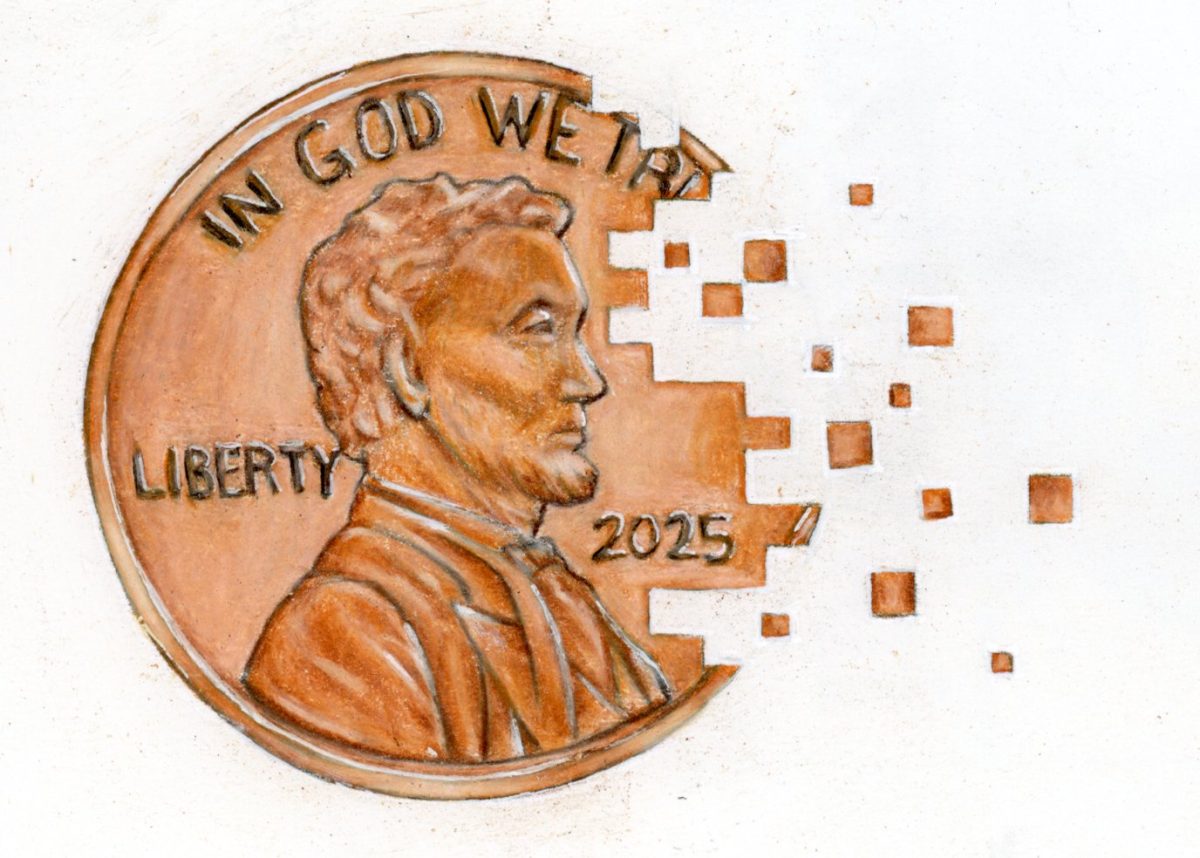
As of Nov. 12, the final penny was minted in the United States. As a result of this, there will be a rounding system implemented, in which purchases will either be rounded to the nearest zero or the nearest five. Purchases with debit cards will not be affected– this only applies to purchases paid with cash. The true effect this will have on everyday life is yet to be determined. Some places and people are going to be more affected than others.
“I’m glad the penny is going away,” said senior Blake Bishop, who works at Hy-Vee.
“No more stupid $9.99. Those prices will probably change to $9.95.” What he said interested me. How will this change affect pricing psychology? Oftentimes, prices for goods and services advertised as “deals” will end in .99. Will sellers change their prices to .95 to maintain an illusion of a good deal, or will they keep the prices at .99?
Joel Cardoza, a senior who works at a local restaurant, doesn’t seem bothered.
“Azteca isn’t affected much by the discontinuation of the penny,” Cardoza said.
“Many customers either pay with their card or leave the change as a tip with the servers,” he said.
The general student population seems to be rather indifferent to the banishment of the penny. Most students typically just pay with their cards or mobile payment apps. However, for those who often deal with cash, dealing with fewer coins could be a favorable idea. Many consumers’ lives become easier as a result of this change.
Candice Freese, bookkeeper here at Millard South, said she believes that the effect of the penny leaving isn’t immediately apparent.
“[The penny]’s been obviously around forever, but will it turn into a collector’s item? If you have a saved bowl full of pennies, is it going to be worth something someday?” she said.
Freese works with cash often, being in charge of cash deposits and fees. However, she said she doesn’t see pennies come through very frequently.
“Yesterday, I had a deposit made from somebody. The Spirit shop, maybe? It had pennies,” she said.
“That was the first time I’ve seen pennies in a long time, in here.”
Freese’s experiences with pennies are reportedly quite rare. Prior to working at Millard South, she worked at a mechanic shop in a small town, and even then, Freese says she hardly worked with pennies.
“I mean, obviously, the bills there were large,” she said.
“You know, but it was a small town, too. If it was like $88.53, somebody was writing a check. It’s something to think about, like, just how it’s going to change. Or, will we even notice it?”
Freese’s experience reflects many of the experiences of the Millard South alumni, primarily digital purchases.
“You know, everything’s gone electronic, with cards, and all the different paypals and venmos and stuff,” Freese said.
The destruction of the penny marks a turning point in our society. Currency is becoming more digital, and coins are becoming more of something to collect, not use.
“I think it’s kind of sad the penny’s going away,” Freese said.
The true effects of the penny on American society and economics will be revealed with time. All that the average American citizen can really do is wait and see. Maybe in a few years, those little copper coins lodged between the cushions of your couch will be worth something.